Article 2
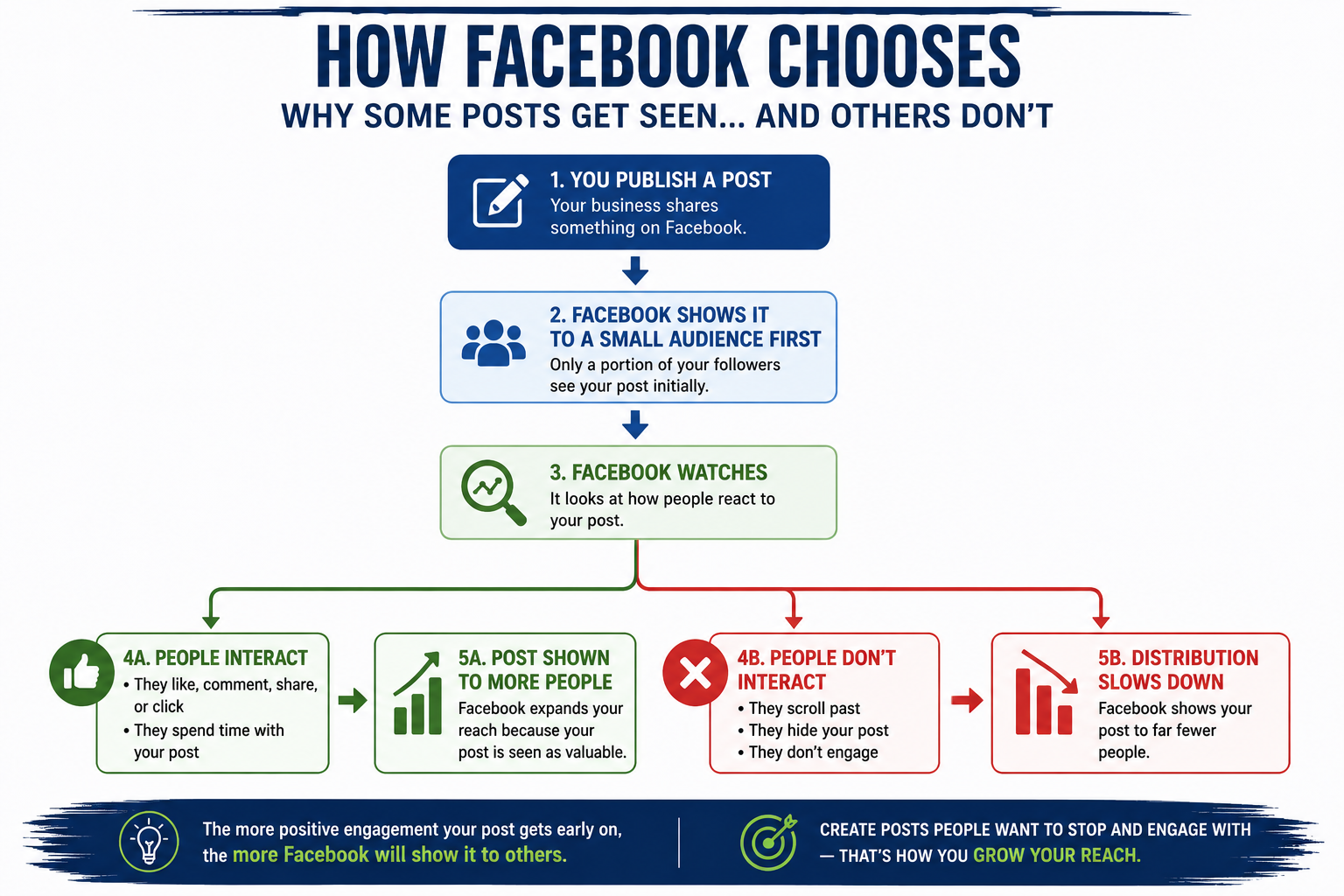
The flowchart above illustrates exactly how Facebook decides whether to show your post to a larger audience—or stop distributing it after the first few people see it.
One of the biggest misunderstandings about Facebook is the belief that everyone who follows a business Page will see everything that Page posts.
That simply is not how Facebook works anymore.
When your business publishes a post, Facebook does not automatically place it in front of all your followers. Instead, its system decides which people are most likely to find the post interesting, useful or entertaining.
That decision is made separately for every person.
There Is More Content Than Anyone Could Possibly See
Think about everything competing for attention when someone opens Facebook:
- Posts from friends and family
- Local news
- Groups they belong to
- Videos and Reels
- Advertisements
- Posts from businesses and organizations
- Recommended content from Pages they do not follow
There is far more content available than anyone could scroll through in one visit.
Facebook therefore has to make choices.
Its ranking system attempts to predict which posts each person is most likely to value. The posts that receive the strongest predictions are placed higher in that person’s Feed. Other posts may appear much farther down—or may not appear during that visit at all.
Following Your Page Does Not Guarantee Visibility
When someone follows your business, they are giving Facebook permission to show them your posts.
They are not telling Facebook that they want to see every post you publish.
Facebook continues watching what that person does.
Do they stop and look at your posts?
Do they click your photographs?
Do they comment, share or visit your Page?
Do they repeatedly scroll past your posts without reacting?
Those behaviors help Facebook decide whether your future posts are likely to interest that individual.
This is why two people who follow the same business Page can have completely different experiences. One person may see nearly every post, while another may rarely see anything from the Page.
Facebook Usually Tests a Post With a Limited Audience
When a Page publishes something, Facebook may initially show it to only a portion of the people who could potentially receive it.
The system then watches what happens.
If people stop scrolling, read the post, view the photographs, comment or share it, Facebook receives evidence that the content may be worthwhile. The post may then be shown to additional people.
If most of the initial viewers scroll past it, Facebook has little reason to expand its distribution.
This is why the first reactions to a post can matter so much.
It also explains why a post that receives very little attention during its first few hours often never reaches a large audience.
Not All Engagement Is Equally Valuable
Businesses frequently assume that the answer is simply to collect more likes.
Likes can help, but they are only one signal.
A thoughtful comment, a share, a link click, a photograph viewed closely or time spent reading may tell Facebook more than a quick reaction.
The important question is not:
“How do I get people to click Like?”
The better question is:
“How do I create something people genuinely want to stop and look at?”
That distinction matters.
Posts that invite real conversation can perform well. Posts that artificially beg for reactions may look forced and can produce little lasting benefit.
Why Business Posts Often Struggle
Many business posts are written like advertisements:
“Stop in today.”
“Call us for more information.”
“Now available.”
“Don’t miss this sale.”
There is nothing inherently wrong with those messages. Businesses occasionally need to make announcements and promote products.
The problem occurs when nearly every post is promotional.
People generally do not open Facebook hoping to see a stream of advertisements. They open it to be entertained, informed, surprised or connected with other people.
A business that only asks people to buy something gives Facebook very little evidence that its content deserves wider distribution.
What Facebook Is More Likely to Reward
The strongest posts usually give people a reason to pause.
That might include:
- A useful explanation
- An interesting behind-the-scenes photograph
- A new product shown in a real setting
- A local story
- A staff or customer accomplishment
- A demonstration
- A surprising fact
- A genuine question people enjoy answering
- Original photographs and video
The content does not have to be professionally produced.
In many cases, a clear photograph taken inside the business and accompanied by an interesting story will outperform a highly polished advertisement.
The key is relevance.
Organic Reach Is Not Completely Gone
Low reach does not mean Facebook is useless for small businesses.
It means businesses must stop thinking of Facebook as a free newspaper where every follower automatically receives every message.
Facebook is now a personalized recommendation system.
Your job is to create posts that give the system evidence that people are interested.
That requires more thought than simply publishing another sales message, but it can still work.
The Practical Lesson
Do not judge your Facebook Page only by how many followers it has.
A Page with 5,000 followers can produce poor results if most followers routinely ignore its posts.
A smaller Page can perform surprisingly well when its audience consistently responds to useful and interesting content.
The goal is not merely to accumulate followers.
The goal is to build an audience that recognizes your business and pays attention when you have something worthwhile to say.
In the next article, I’ll explain five practical ways small businesses can increase their Facebook reach without simply spending more money.
The difference between Facebook a few years ago and Facebook today can be summed up in one simple comparison. If you only remember one thing from this article, let it be this:
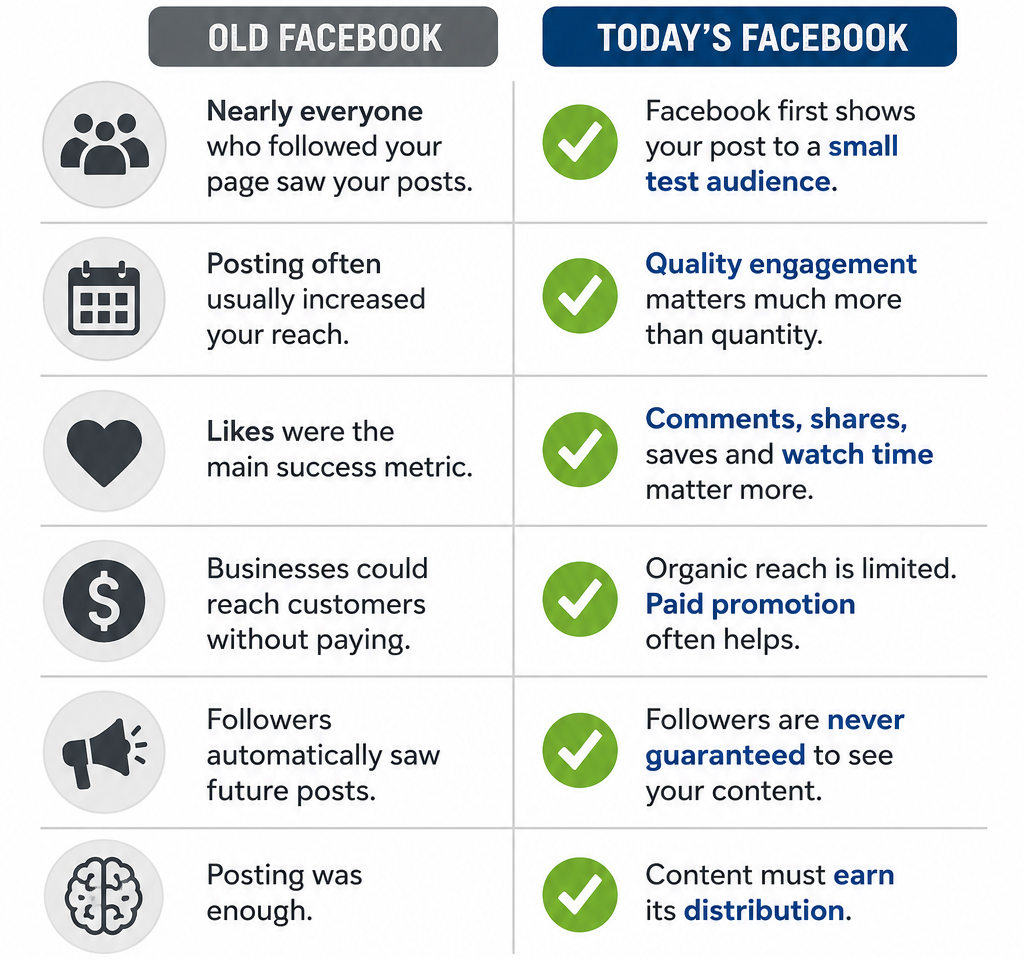
Facebook didn’t stop working. It simply changed the rules. Businesses that understand those new rules are still seeing excellent results.
Coming Next Week
Article 3
5 Ways to Increase Facebook Reach Without Spending More Money
You’ll learn:
- what kinds of posts Facebook prefers
- why comments matter more than likes
- the best time to ask questions
- how to get people to stop scrolling
- one mistake that quietly kills reach
Recent Comments