
(And How to Fix It)
A few years ago, if you had a good email list, open rates of 35% or even 40% weren’t unusual. Today, many businesses are wondering why those same email campaigns struggle to reach even half that number.
Has email stopped working?
Not at all.
Just like Facebook, email has changed. Today’s email providers are working harder than ever to protect users from spam and unwanted messages. That means businesses must follow a new set of rules if they want their emails to consistently reach the inbox.
Here are some of the biggest reasons email open rates have changed—and what you can do about them.
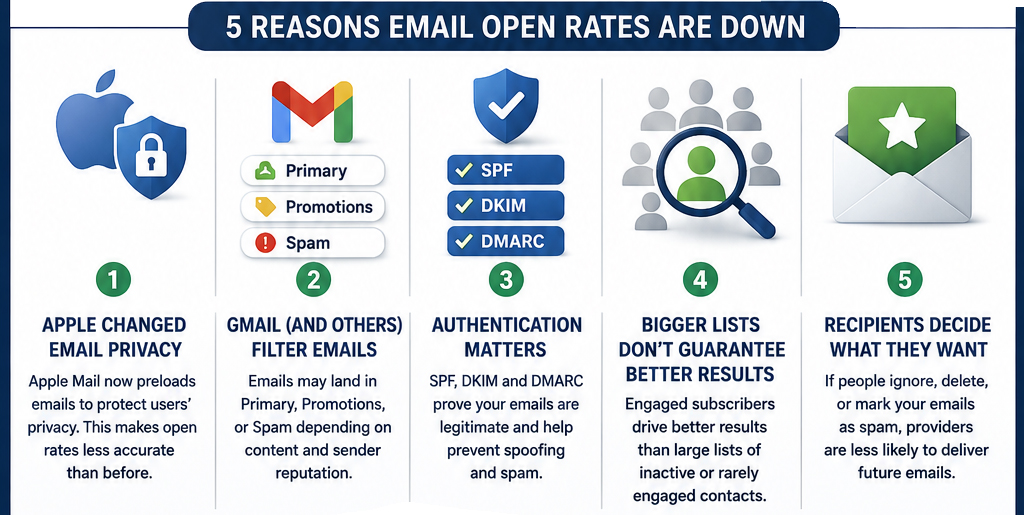
Apple Changed the Way Email Opens Are Measured
Apple introduced new privacy features that changed the way marketers measure email opens. To better protect users’ privacy, Apple Mail often preloads email content before the recipient actually reads it.
As a result, an email may appear as “opened” even if the recipient never actually looked at it. This has made email open rates less reliable than they once were and has forced marketers to rely on additional metrics like click-through rates and overall engagement.
Gmail Doesn’t Treat Every Email the Same
Not every email automatically lands in your customer’s primary inbox anymore.
Services like Gmail, Yahoo, Outlook and others now use sophisticated algorithms to determine where incoming emails belong. Depending on the content and the sender’s reputation, your email may land in the Primary, Promotions, or Spam folder.
Landing in the Promotions tab isn’t necessarily bad—many people check it regularly—but emails placed there often receive less attention than those appearing in the Primary inbox.
These filtering systems are constantly evaluating every email they receive, looking for signs that help determine whether the message is valuable or simply another advertisement.
Quick Tip
If your email lands in the Promotions tab, don’t panic. Many customers regularly check their Promotions folder. The bigger goal isn’t avoiding Promotions at all costs. The goal is staying out of Spam and consistently sending content people want to receive.
Authentication Matters More Than Ever
One of the biggest changes over the past few years is the increased importance of email authentication.
Today, legitimate businesses should have three important security records connected to their domain:
- SPF (Sender Policy Framework)
- DKIM (DomainKeys Identified Mail)
- DMARC (Domain-based Message Authentication, Reporting and Conformance)
Together, these tools help prove that your emails are genuinely coming from your business and not from someone pretending to be you.
If these records are missing or incorrectly configured, email providers are much more likely to treat your messages as suspicious, increasing the chances they end up in the spam folder instead of your customer’s inbox.
Bigger Lists Don’t Automatically Produce Better Results
Many businesses assume that the larger their email list, the better their results.
In reality, the opposite is often true.
A list of 500 engaged subscribers can easily outperform a list of 5,000 people who rarely open your emails.
Email providers monitor how recipients interact with your messages. If large numbers of people ignore your emails, delete them without opening them, or mark them as spam, your sender reputation begins to suffer. Over time, that makes it harder for future emails to reach the inbox.
This is why maintaining a clean, engaged email list is far more important than simply having the largest possible audience.
What Still Works
The good news is that email marketing remains one of the most effective ways to stay connected with your customers. The key is following today’s best practices.
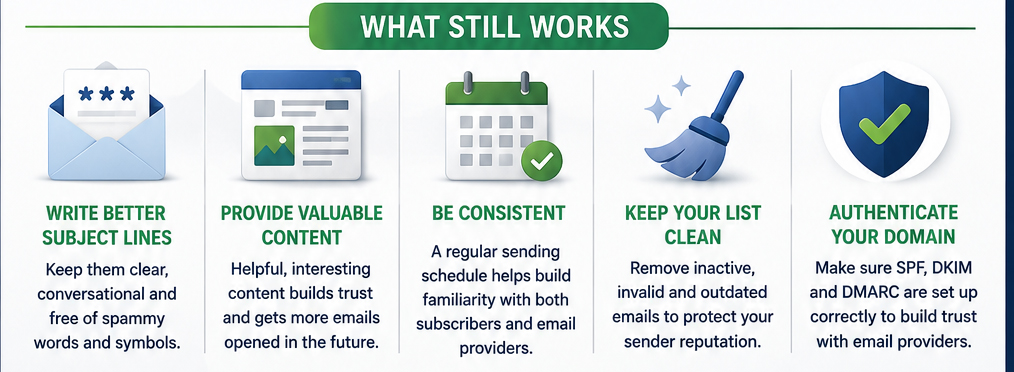
Write Better Subject Lines
Avoid subject lines filled with excessive capital letters, multiple exclamation points, or language that sounds overly promotional. Simple, conversational subject lines often perform much better.
Provide Valuable Content
People are far more likely to open future emails if your previous messages were helpful, interesting, or educational instead of simply promoting another sale.
Be Consistent
Businesses that send emails on a regular schedule generally build stronger subscriber engagement than those that send only occasionally or at random.
Whether you send weekly, monthly, or quarterly, consistency helps establish trust with both your subscribers and the email providers.
Keep Your List Clean
Remove inactive addresses, outdated email accounts, and suspicious-looking addresses that may have been added by bots or spammers. A healthier list usually leads to higher open rates and better deliverability.
The Bottom Line
Just like Facebook, email didn’t stop working—the rules simply changed.
Businesses that understand those changes are still seeing excellent results.
Over the past several months I’ve been implementing these best practices for both my own campaigns and those of several clients. By cleaning email lists, properly authenticating domains, sending more valuable content, and focusing on engaged subscribers, I’ve seen open rates improve dramatically.
If your email open rates have been declining, don’t assume email marketing no longer works. More often than not, it’s simply a matter of adapting to today’s email environment.
Five Steps You Can Take Today
If you’re looking to improve your email results, start here:
- Verify and clean your email list using a service like NeverBounce or ZeroBounce.
- Remove inactive and suspicious email addresses.
- Make sure your domain is properly authenticated with SPF, DKIM, and DMARC.
- Send emails consistently instead of only occasionally.
- Focus on providing helpful, valuable content your subscribers actually want to receive.
Businesses that follow these practices are much more likely to reach the inbox—and much more likely to build stronger relationships with their customers.
Recent Comments