Over the past several weeks, we’ve looked at how Facebook and email marketing have changed.
We’ve talked about why Facebook doesn’t show every post to every follower, what businesses can do to improve their Facebook reach, why email open rates have changed, and what actually gets someone to open an email.
For the final article in this series, I want to answer a question I hear from many small business owners:
What should I actually be sending my customers?
That’s where many businesses get stuck.
They know they should stay in touch. They may have a Facebook page and a customer email list. But after a while, they run out of things to say.
The answer is simpler than you might think.
You don’t always need a sale. You don’t need a big announcement. And you certainly don’t need to create something elaborate every week.
You just need to give people a reason to pay attention.
1. Answer the Questions Your Customers Already Ask
One of the easiest ways to come up with useful content is to think about the questions customers ask you every day.
If one customer asks a question, chances are other customers are wondering the same thing.
A hardware store might explain which grass seed works best in different conditions.
A furniture store might explain the difference between various mattress types.
A restaurant might show how one of its popular dishes is prepared.
A service business might explain when it’s time to repair something and when it’s time to replace it.
You already have the knowledge. You’re simply sharing it with more people.
And that’s useful content.
2. Show People Things They Normally Don’t See
People are naturally curious about what happens behind the scenes.
Show a new shipment arriving.
Introduce an employee.
Show how a product is made, installed or repaired.
Take people behind the scenes of a project.
Show a before-and-after.
These kinds of posts don’t necessarily feel like advertising, and that’s exactly why they can work so well.
They give customers a chance to know your business better.

3. Tell Stories Instead of Just Selling Products
Suppose you own a furniture store and a new dining room set arrives.
You could post:
New dining set now available. $1,499.
There’s nothing wrong with that.
But you could also show the dining set in a beautiful room and talk about Sunday dinners, holiday gatherings and having the family together around the table.
You’re selling the same dining set.
But now you’re helping the customer imagine what owning it might mean to them.
People don’t just buy products. They buy what those products can do for them.
Good marketing helps them picture that.
4. Give People a Reason to Participate
Remember what we discussed earlier in this series about Facebook?
Comments and meaningful engagement can help your content reach more people.
So don’t always talk at your audience.
Sometimes ask them something.
A garden center could show two flower combinations and ask which one people prefer.
A restaurant could ask customers to choose between two favorite menu items.
A clothing store could show two outfits and ask which one they’d wear.
The important thing is that the question should feel natural.
Don’t ask a question just to trick people into commenting.
Start a conversation people might actually want to join.
You Don’t Need Separate Ideas for Facebook and Email
Here’s something else that can make all of this easier.
One good idea can often be used in several places.
Suppose you write a short article answering a common customer question.
That article can become:
- a post on your website
- an email to your customers
- a Facebook post
- several shorter social media posts
- a short video
You don’t have to start over every time.
Create something worthwhile once and find several ways to use it.
That’s exactly what I’ve been doing with this Marketing Insights series.
Each article appears on my website. I email it to subscribers. And the ideas can also be used in social media and conversations with clients.
One idea can do a lot of work.
The Real Goal Is to Stay Relevant
There’s a reason I’ve spent six articles talking about Facebook and email together.
They’re different tools, but they can accomplish the same important goal:
Keeping your business in front of people who already know you.
Not everyone needs what you sell today.
Someone may not need a new sofa today.
They may not need a plumber today.
They may not be ready to buy a new car, replace an appliance or schedule a service today.
But someday they will.
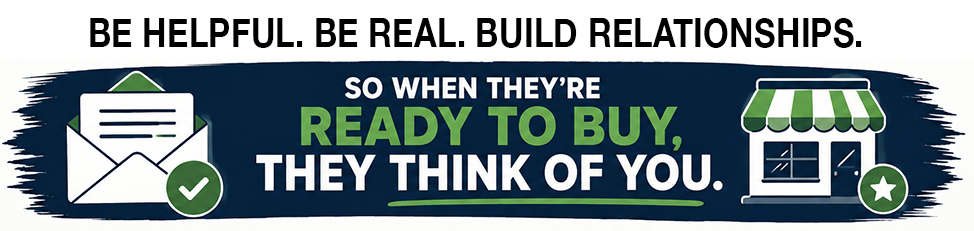
The goal of good marketing is to make sure that when that day comes, your business is one of the businesses they think about.
You don’t accomplish that by constantly shouting louder.
You accomplish it by staying useful, interesting and familiar.
The Bottom Line
Facebook has changed.
Email has changed.
And they’ll continue to change.
The businesses that succeed won’t necessarily be the ones that figure out every new algorithm or chase every new marketing trend.
They’ll be the businesses that remember something much more basic:
There are real people on the other side of all this technology.
Give them something useful.
Give them something interesting.
Give them a reason to remember you.
And when they’re ready to buy, you’ll have a much better chance of being the business they think of first.
Recent Comments