
Last week we looked at why email open rates aren’t what they used to be. Spam filters have become more sophisticated, email authentication has become more important, and services like Gmail and Apple Mail have changed the way emails are delivered and measured.
But getting your email into someone’s inbox is only half the battle.
Once it’s there, what actually makes someone open it?
That’s a question I’ve been paying particularly close attention to while sending this Marketing Insights series.
The answer isn’t simply writing a clever subject line.
A good subject line certainly helps. But whether someone opens your email depends on several things—and one of the most important may be what happened the last time you emailed them.
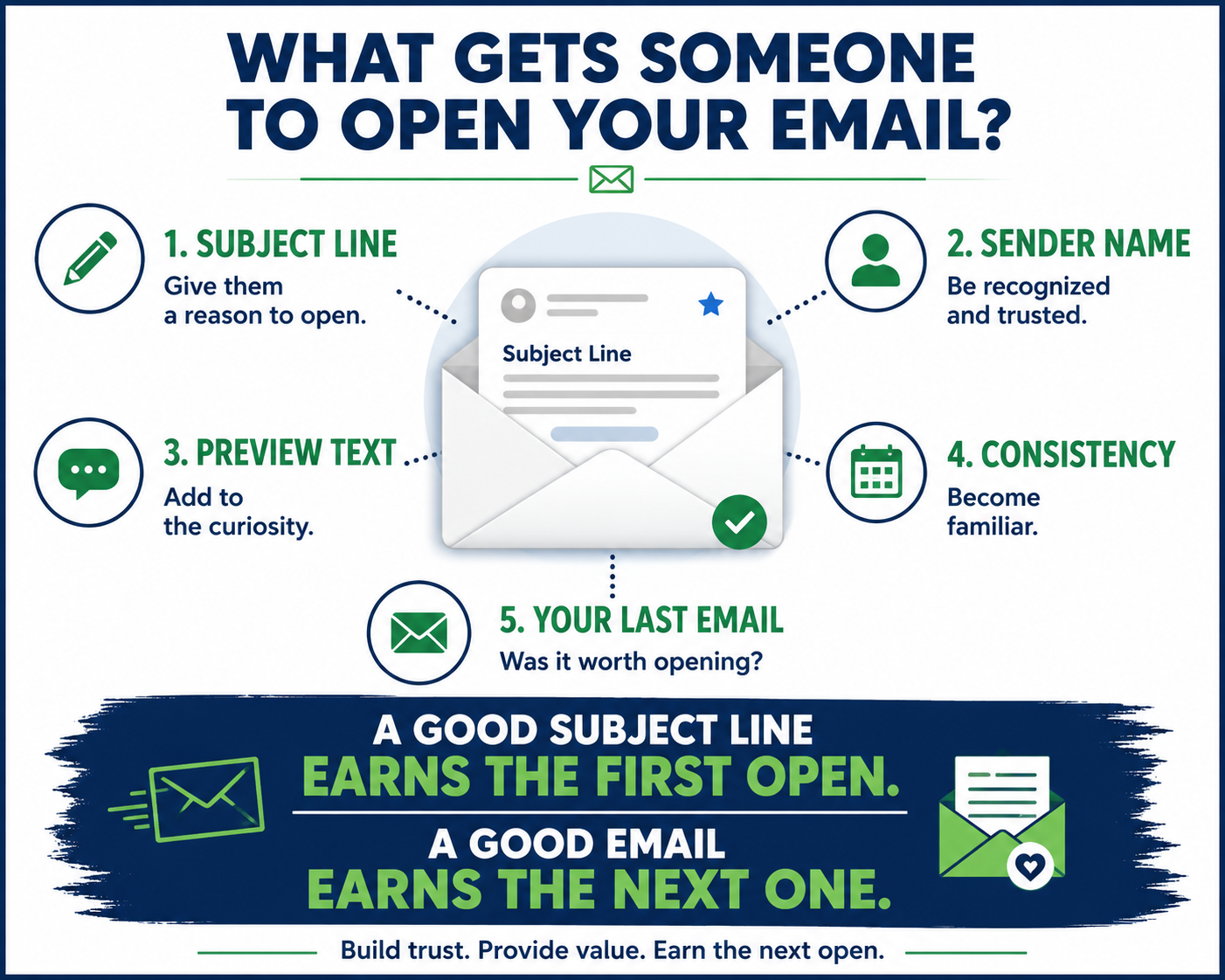
1. Your Subject Line Has One Job
Your subject line doesn’t have to sell your product.
It doesn’t even have to explain everything that’s in the email.
Its job is to give someone a reason to open it.
That’s why simple questions can work so well.
For example, the subject line for my last Marketing Insights email was:
Why are fewer people opening your emails?
It addressed a problem many business owners recognize immediately, but it didn’t give them the answer. To get the answer, they had to open the email.
Compare that with a subject line like:
5 Ways to Improve Your Email Marketing
There’s nothing necessarily wrong with it, but it sounds more like advertising. It’s also something we’ve all seen dozens of times.
A good subject line creates just enough curiosity to make someone think:
“I’d like to know the answer to that.”
2. People Look at Who Sent the Email
Before opening an email, most of us make another decision almost automatically:
Who is this from?
An interesting subject line from someone you don’t recognize may get ignored. An email from a person or business you know and trust has a much better chance.
That’s why building familiarity matters.
If your business sends useful emails consistently, customers begin recognizing your name in their inbox.
Over time, that recognition can become just as important as the subject line itself.
This is also one reason I send these Marketing Insights emails from AIM Advertising rather than using a vague or unfamiliar sender name. I want subscribers to immediately know who’s contacting them.
3. Don’t Forget About the Preview Text
The preview text is the short line that appears next to or underneath the subject line in most inboxes.
It’s valuable space, yet many businesses completely overlook it.
Think of the subject line and preview text as a team.
For my last email, I used:
Subject: Why are fewer people opening your emails?
Preview: Email still works. The rules have simply changed.
The preview didn’t repeat the subject line. It added another piece of information and gave the reader another reason to become curious.
Instead of treating preview text as an afterthought, use it to continue the thought you started in your subject line.
4. Consistency Matters
I’ve been sending this Marketing Insights series at approximately 9:00 Wednesday mornings.
There’s nothing magical about Wednesday at 9:00.
Different audiences have different habits, and there isn’t one perfect time that works for every business.
What matters more is consistency.
If someone receives useful information from your business regularly, your emails can eventually become familiar. Readers begin to recognize your name, your format and the kind of information you provide.
Compare that with a business that sends nothing for six months and suddenly sends three promotional emails because it’s having a sale.
Which sender are you more likely to recognize and trust?
Consistency helps build that relationship.
5. Your Last Email May Determine Whether They Open Your Next One
This may be the most important lesson of all.
The best way to get someone to open your next email is to make sure they were glad they opened your last one.
If every email you send says:
SALE!
20% OFF!
BUY NOW!
people eventually learn what to expect before they even open it.
Some promotions are important, of course. Email is a great way to tell customers about sales, new products and special events.
But that shouldn’t necessarily be the only reason you contact them.
Give people information they can use.
Answer questions.
Teach them something.
Show them something interesting.
Give them a reason to believe that opening an email from your business is worth a few minutes of their time.
That’s exactly what I’m trying to accomplish with this Marketing Insights series.
What I’ve Learned From This Series So Far
I’ve now sent four Marketing Insights emails to essentially the same audience, at approximately the same time of day.
The reported open rates have ranged from about 27% to nearly 35%.
Because today’s email systems sometimes automatically open or scan messages for security and privacy reasons, open-rate statistics aren’t as precise as they once were. But comparing similar campaigns can still give us useful clues about what interests an audience.
One thing I’m seeing is that the topic and the way the subject line presents it matter.
My most recent email, “Why are fewer people opening your emails?”, produced the highest reported open rate of the first four emails in this series.
That’s not enough data to declare we’ve discovered the perfect subject line.
But it does reinforce something I’ve believed for a long time:
Good marketing starts by thinking about what matters to the customer—not what the business wants to sell.
Before You Send Your Next Email
Take a minute and look at your email as if you were the customer receiving it.
Ask yourself:
Would I recognize who this is from?
Does the subject line give me a reason to open it?
Does the preview text make me more curious?
Have this company’s previous emails been worth reading?
And perhaps most importantly:
If I open this email, will I be glad I did?
If the answer to those questions is yes, you’re already doing many of the things that help build a successful email marketing program.
The Bottom Line
Getting more people to open your emails isn’t about finding a magic word to put in the subject line.
It’s about building a relationship.
A good subject line earns the first open.
Consistently sending worthwhile emails helps earn the next one.
And over time, that’s far more valuable than any subject-line trick.
Recent Comments